Modern Language
The modern language department prepares students to communicate successfully in Chinese, French, or Spanish in both local and global contexts. Students completing the program understand culturally diverse perspectives and demonstrate competency in interpretive, interpersonal, and presentational communication skills.
In order to achieve these goals, students are required to complete up to level 3 in one language, or follow one of the alternatives outlined below. Note: all students are encouraged to study language all four years in order to take full advantage of our program, including exchange and travel opportunities.
Students study Chinese, French, or Spanish in the 9th Grade and may add a second language in the 10th, 11th, or 12th Grade, space permitting. Current and new Park students with previous language experience will take an assessment in the spring to ensure placement where the department feels students will be most successful.
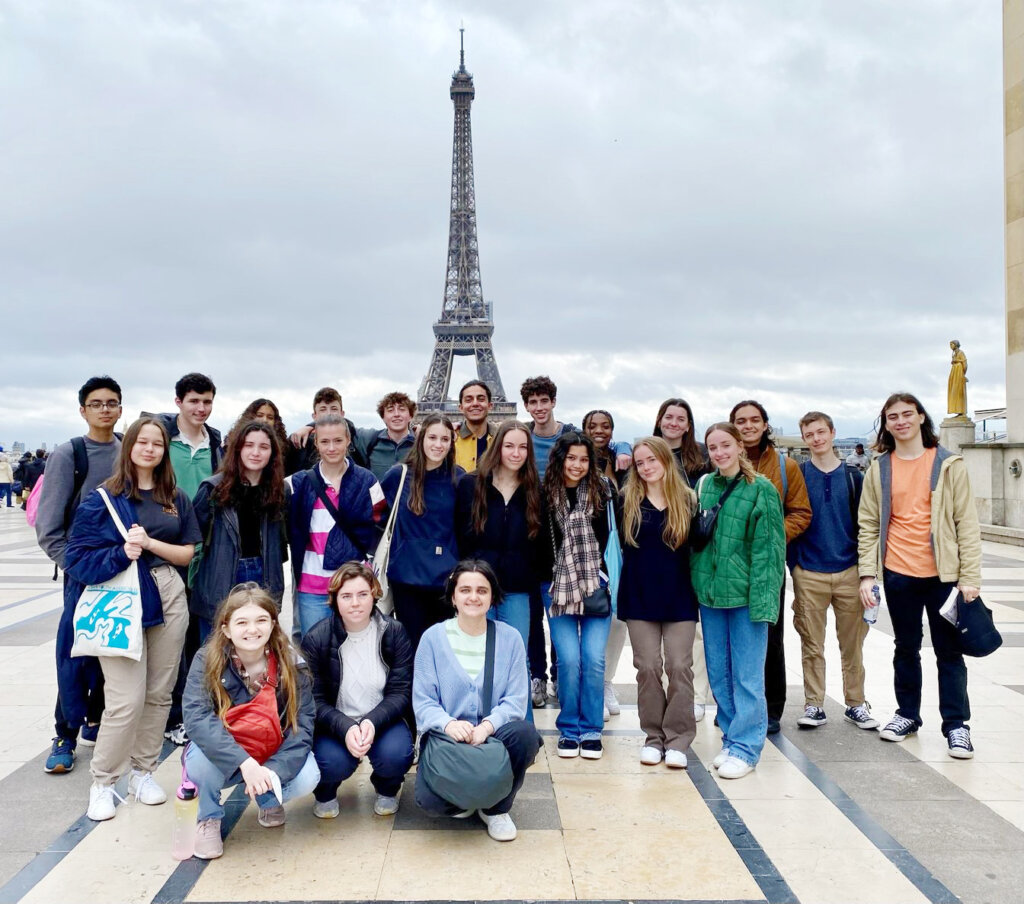
Students typically have the opportunity every other year to participate in exchange programs in China, France, and a Spanish-speaking country. While abroad, they live with host families, attend classes at our sister schools, and engage in cultural activities. Back in Baltimore, exchange participants act as hosts when their partners visit Park. Participation is dependent on approval by the faculty and the student’s commitment to continue enrollment in the target language in the following year.
Accelerated courses provide qualified students with a greater challenge and expect students to work at an advanced level in all skills. When offered, and with the approval of the department to enroll, the Intensive course in French or Spanish prepares students for the AP exam. Regardless of level, all of our courses are conducted in the target language and emphasize cultural themes and oral proficiency. In addition, language and intercultural competency skills are reinforced through grammar review and opportunities to use the language in a variety of contexts.
Requirements and Placement
There are several options to fulfill graduation requirements in languages based on where students are placed when they enter Park’s Upper School.
Students who are placed in Levels 1 or 2, and students beginning the study of a new language, must choose between:
- Successfully completing through Level 3 in their tested language or in a new language
- Successfully completing through Level 2 in two different languages that are new to them
All 9th Grade students who are placed in Level 3 must choose between:
- Successfully completing Level 3 in their placed language and an additional year of study in this language (two years in Upper School language program)
- Successfully completing up to Level 2 in a new language
All 9th Grade students who are placed beyond Level 3 (native speakers) must begin a new language and complete through level 3 or complete two years of two new languages.
Special Circumstances
LANGUAGE WAIVER:
Students with a language waiver are exempt from completing the Park’s language requirement, but are encouraged to try a language class at Park.
NEW 10TH, 11TH, AND 12TH GRADERS:
Students who tested below Level 3 must continue through Level 3 or complete two years of another language. Students who test above Level 3 are encouraged to continue the language of their study or try a new language class at Park.
STUDENTS WHO ATTEND PARK AS PART OF AN EXCHANGE OR STUDY ABROAD PROGRAM:
Exchange and study abroad students are not required to enroll in language during their stay. Students may enroll in a language course, at the appropriate level, different from their native language, or may apply to become a Teaching Assistant to share their experience and expertise in one of our Chinese, French, or Spanish courses.
INTERNATIONAL STUDENTS FOR WHOM ENGLISH IS NOT THEIR FIRST LANGUAGE:
International students entering Park as 9th, 10th, or 11th Graders are required to complete Level 1 of a language different from their native language during their first or second year at Park. International students entering Park in 12th Grade are not required to study a new language, but are invited to do so.
Chinese
Chinese 1
Grades: 9-12
Chinese 1 is the introductory course of Chinese language and culture. Students are expected to become proficient at Pinyin (the phonetic system), learn to communicate with people on simple, everyday topics, and recognize approximately 300 characters by the end of the year. Students will also have a taste of Chinese traditions, history, geography, modern society, popular culture, etc., through presentations, songs, movies, doing research by themselves, and many other activities.
Chinese 2 (Regular and Accelerated)
Grades: 9-12 • Prerequisite: Chinese 1
This course is a continuation of Chinese 1. Students continue to focus on various aspects of Chinese culture, and oral proficiency. As they practice hearing and producing the four tones and expand their vocabulary, they learn to talk about additional topics, including hobbies, school life, and trips. Students will learn hundreds of characters, and they will also learn how to write with the proper stroke sequence. By the end of the year, students who can recognize around 400 Chinese characters without the help of Pinyin and write 200 characters without a model will be given accelerated credit.
Chinese 3 (Regular and Accelerated)
Grades: 10-12 • Prerequisite: Chinese 2
Chinese 3 is a continuation of Chinese 2. It is taught mainly in Chinese, while English is only used to explain grammar and introduce aspects of culture. Students are expected to be proficient and accurate in the four tones and Pinyin. They continue to expand their vocabulary and learn hundreds of characters during the year. By the end of this program, they are expected to be able to communicate with native speakers on many topics, especially those related to everyday life. Included in the goals for the year are expanded listening comprehension with an emphasis on understanding more rapid speech and a deeper understanding of China and its people. By the end of the year, students who can recognize around 600 Chinese characters without the hlep of Pinyin and write 300 characters without a model will be given accelerated credit.
French
(Re) Introduction to French (French 1)
Grades: 9–12
This course is geared towards true beginners, as well as students who took French in Middle School and need more time and exposure to build a strong foundation to be ready for level 2. In this course, students will acquire communicative skills and cultural knowledge in order to engage in a variety of everyday situations while discovering the diversity of the Francophone world. In addition, this course will develop the tools and habits of mind for students to become independent language learners. Students will work on all four communication skills with an emphasis on oral proficiency. Students learn to only speak French in the classroom.
French 2 and French 2 (Accelerated)
Grade: 9 • Required
In this language and culture course, students build on their French 1 or Middle School French foundation. The course takes a thematic approach to language learning and recognizes the relationships between cultural awareness, communication, vocabulary acquisition, and grammar. An emphasis is placed on cultural competency and oral proficiency, with assessments incorporated into the program. Class content is based on the topics of everyday life. Activities include listening to songs, engaging in conversations, writing short compositions, and reading personal narratives. Students are expected to use French in the classroom. The accelerated course moves at a quicker pace, and students tackle more complex texts and material. Students in the accelerated class are expected to work more independently and with less support.
French 3 and French 3 (Accelerated)
Grade: 10 • Required • Prerequisite: French 2
This class follows the same integrated approach used in French 2. Students build upon their knowledge of French language and their understanding of French-speaking cultures around the world. They are expected, with support, to read and write more independently and to make connections based on previous knowledge. Class content is based on cultural themes (e.g., secularism, folklore, music, the environment) and may vary depending on the year. Cultural competency and oral proficiency are still emphasized. In the accelerated section, students are expected to communicate with greater accuracy and to develop their ideas more fully.
Spanish
Spanish 1
In this introductory course, students will acquire the communicative skills and cultural knowledge to be able to engage in a variety of practical situations while discovering the diversity of the Spanish-speaking world. In addition, this course will develop the tools and mindset to become independent language learners. Students will work on all four communication skills with an emphasis on oral proficiency. Culture is integrated into all aspects of the program, and students are encouraged to speak Spanish in the classroom.
Spanish 2 and Spanish 2 (Accelerated)
Grade: 9 • Required
In this course, students build on their Middle School or Spanish 1 foundation and continue to develop their interpersonal communicative skills and to deepen their cultural knowledge. Through authentic materials, students continue to explore the depth and diversity of the Spanish-speaking world. This course will review strategies for language learning so that students will continue to build their tools and mindset to be independent language learners. Grammar and vocabulary are integrated into thematic units. Students are expected to use Spanish in the classroom. The accelerated course moves at a quicker pace, and students tackle more complex texts and material. Students in the accelerated class are expected to work more independently and with less support.
Spanish 3 or Spanish 3 (Accelerated)
Grade: 10 • Required • Prerequisite: Spanish 2 or Spanish 2 Accelerated (permission of the department for the accelerated level)
In Spanish 3, the curriculum shifts towards a thematic and integrated approach. Students are expected, with support, to read and write more independently, and engage in dialogue. Through the use of authentic texts and films, students learn new vocabulary and grammar, and, as they consider the themes presented, apply and expand their knowledge. In the accelerated section, students will be expected to communicate with greater accuracy and develop their ideas more fully.
Intensive Spanish Language and Culture (Accelerated)
Grade 11 • Prerequisite: Spanish 3 Accelerated and permission of the department.
The focus of this course is the acquisition of a high degree of communicative and cultural competency in Spanish. The approach is a thematic one in which students consider, through the vehicle of films, literary texts, newspaper articles, podcasts, etc., topics related to global challenges, science and technology, and personal and public identities. Students will strengthen their interpretive, interpersonal, and presentation skills while reinforcing their knowledge of grammar and expanding their vocabulary. This course prepares students for the Advanced Placement (AP) Spanish Language and Culture examination in the spring. Prerequisite: Spanish 3 Accelerated and permission from the department.
Chinese
Chinese 4: Ancient Chinese History
Grades: 11-12 • Prerequisite: Chinese 3 or the equivalent. This class is offered in alternate years and will be offered this year but will not be offered in 2027-2028.
In this course, students focus on ancient Chinese history, which to some degree has shaped who the Chinese people are today. Topics include most famous dynasties such as Han and Tang, influential thinkers including Confucius, a taste of ancient poetry, and some interesting events that took place over thousands of years. An emphasis is placed on discussion, research, and independent work. Through this content-based course, students gain a deeper understanding of China and its people while they continue to improve their language skills.
Modern Chinese History
Grades: 11-12 • Prerequisite: Chinese 3 or the equivalent. This class is offered in alternate years and will not be offered this year, but will be offered in 2027-2028.
In this course, students will focus on modern Chinese history. Topics will include the late phase of Qing Dynasty, the “Century of Humiliation,” the Civil War, in addition to the rise of China in recent decades, etc. Emphasis will be placed on discussion, research, and independent work. Through this content-based course, students will gain a deeper understanding of China and its people while they continue to improve their language skills.
French
A la découverte de l’héritage culturel judéo-marocain
Grades: 11-12 • Prerequisite: French 3 (Accelerated) or permission of the department.
Morocco has been a vibrant center of Jewish life for millennia; the Jewish population of Morocco was at its peak in the ‘40s reaching almost three hundred thousand people; it was the biggest non-Ashkenazi community in the world and the largest Jewish community in the Muslim world. This course will explore Francophone Moroccan-Jewish voices through their narratives of cultural Moroccan Jewish Heritage. This course will introduce through Francophone Moroccan Jewish literature, music, documentaries, and films the diverse influences of Francophone Moroccan Jewish Cultural Heritage in Morocco, and in other Francophone societies such as Canada and France. Students will have the opportunity to research, discuss, and reflect on many aspects of the historical, social, and cultural background of what was once the largest Jewish community in a Muslim country and the distinct Moroccan Jewish culture that has developed over the centuries.
La Conversation (Accéléré)
Grades: 11-12 • Prerequisite: French 3 (Accelerated) or permission of the department.
In this class, students will learn to feel very comfortable speaking French. Through role playing and improvisational activities, they will learn how to communicate in real-life situations. The class will study dialogues, which students will then be able to apply to talk with friends, meet new people, and engage with the world in all the ways they do in their native language. Each class will include a pronunciation lecture and practice. Students will also learn about enunciation vs articulation and will explore strategies to help express themselves orally even when they do not have the necessary vocabulary to do so. Two major assignments include a passion project, and an eloquence speech modeled after the yearly “Concours d’éloquence” contest from the Sorbonne University in Paris.
Spanish
En las noticias: perspectivas del mundo hispanohablante
Grade 12 • Prerequisite: Spanish 3, Spanish 3 (Accelerated) or permission of the department.
In this course, students will read, watch, and analyze the news produced in Spanish-speaking communities and countries. They will compare and contrast how news sources report and prioritize stories about current events, and how they use cartoons, graphics, and photos to inform and engage their readers. Students will learn how journalists structure news articles, features, reviews, interviews, and commentaries, and produce their own Spanish-language newspaper.
Latinos en el mundo and Latinos en el mundo (Acelerada)
Grades: 11-12 • Prerequisite: Spanish 3, Spanish 3 (Accelerated), or permission of the department for accelerated level.
This course provides an overview of the rich cultural heritage of hispanic countries, focusing on art, music, and cultural traditions. Through a combination of readings, discussions, and multimedia presentations, students will gain an understanding of the historical, social, and political contexts that have shaped Hispanic culture. By the end of the course, students will have a broad understanding of the unique cultural traditions of different hispanic countries, as well as an appreciation for the ways in which these traditions continue to evolve nowadays. Students will improve their speaking and collaborative skills through hands-on and oral communicative activities.
Advanced Topics in Spanish: From Silent to Talkie
Grades: 11-12 • Prerequisite: Intensive Spanish Language and Culture or permission of the department.
In this hands-on and fast-paced course, students will immerse themselves in the exciting world of Hispanic film analysis and film production. They will explore the origins of the moving image—from silent cinema to modern talkies in Latin America and Spain—while deepening their cultural knowledge and sharpening their Spanish communication skills. The course emphasizes immediate application: as soon as a conceptual film technique is introduced, students put it into practice. Students will develop advanced oral expression, gesticulation, and intonation by creating original scripts and performing dialogues. Teamwork is essential, as students will collaborate in groups to write, shoot, and edit short films under tight deadlines. This immersive approach effectively builds creative fluency and expressive confidence.oken Spanish. This hands-on approach helps build confidence, overcome language challenges, and develop fluency in a creative way.
Chinese
Chinese 4: Chinese Culture Past and Present
Grades: 11-12 • Prerequisite: Chinese 3 or the equivalent. This class is offered in alternate years and will be offered this year, but will not be offered in 2027-2028.
In the spring semester, students continue to learn Chinese language through the study of Chinese culture covering topics ranging from Chinese medicine to music, education, and other topics of contemporary society. An emphasis is placed on discussion, research, hands-on projects, and independent work. Through this content-based course, students gain a deeper understanding of China and its people while they continue to improve their language skills. By the end of the year, students who can recognize around 800 Chinese characters without the help of Pinyin and write 400 characters without a model will be given accelerated credit.
Chinese Society Through Film
Grades: 11-12 • Prerequisite: Chinese 3 or the equivalent. This class is offered in alternate years and will not be offered this year, but will be offered in 2027-2028.
In the spring semester, students will learn about Chinese society through the study of Chinese films that cover topics ranging from ancient and modern history to the educational system to growing up in China, etc. Emphasis will be placed on discussion, research, and independent work (e.g., film reviews). Through this content-based course, students
French
A la découverte de l’héritage culturel judéo-marocain
Grades: 11-12 • Prerequisite: French 3 or French 3 (Accelerated)
Morocco has been a vibrant center of Jewish life for millennia; the Jewish population of Morocco was at its peak in the ‘40s reaching almost three hundred thousand people; it was the biggest non-Ashkenazi community in the world and the largest Jewish community in the Muslim world. This course will explore Francophone Moroccan-Jewish voices through their narratives of cultural Moroccan Jewish Heritage. This course will introduce through Francophone Moroccan Jewish literature, music, documentaries, and films the diverse influences of Francophone Moroccan Jewish Cultural Heritage in Morocco, and in other Francophone societies such as Canada and France. Students will have the opportunity to research, discuss, and reflect on many aspects of the historical, social, and cultural background of what was once the largest Jewish community in a Muslim country and the distinct Moroccan Jewish culture that has developed over the centuries.
La conversation
Grades: 11-12 • Prerequisite: French 3 or French 3 (Accelerated) or permission of the department.
In this class, students will learn to feel more comfortable speaking French. Through role playing and improvisational activities, they will learn how to communicate in real-life situations. The class will study dialogues, which students will then be able to apply to talk with friends, meet new people, and engage with the world in all the ways they do in their native language. Students will also practice pronunciation and learn strategies to help them express themselves orally even when they don’t have all the vocabulary they need.
Spanish
En las noticias: perspectivas del mundo hispanohablante (Acelerada)
Grades: 11-12 • Prerequisite: Spanish 3, Spanish 3 Accelerated, and permission of the department.
In this course, students will read, watch, and analyze the news produced in Spanish-speaking communities and countries. They will compare and contrast how news sources report and prioritize stories about current events, and how they use cartoons, graphics, and photos to inform and engage their readers. Students will learn how journalists structure news articles, features, reviews, interviews, and commentaries, and produce their own Spanish-language newspaper. This course includes a review of advanced grammatical topics and verb tenses related to understanding and reporting the news.
Advanced Topics in Spanish 2 (Accelerated): Descolonizando la comida
Grades: 11-12 • Prerequisite: Intensive Spanish or permission of instructor.
This class centers on the historical and cultural background of the foods from Latin America, the Caribbean, and Spain. Students will learn about the origins of foods from those regions, the cultural influences and different traditions, as well as why food is so important in Hispanic culture. Through a decolonial lens, students will examine how Indigenous and African influences have shaped food systems, culinary practices, and cultural identities across the Hispanic world. Students will discover this information through the examination of historical, literary, digital, and visual materials and will ideally have the chance to develop their culinary expertise!
Conversaciones Culturales
Grades: 11-12 • Prerequisite: Spanish 3, Spanish 3 (Accelerated), or permission of the department.
This course is designed for Spanish learners who wish to deepen their understanding of the Spanish-speaking world through discussion of contemporary cultural topics. Students will engage with films, literature, articles, and other authentic materials while developing their ability to analyze, discuss, and write about cultural issues and diverse perspectives. Emphasis is placed on building confidence and proficiency in spoken and written Spanish, as well as strengthening intercultural understanding and critical thinking skills.
Entre Istmos: Cultura e Identidad en Centroamérica (Acelerada)
Grades: 11-12 • Prerequisite: Spanish 3, Spanish 3 (Accelerated) or permission of the department.
In this class, students will explore the rich culture, history, and identity of Central America. Together, they will learn about all Hispanic Central American countries: Costa Rica, El Salvador, Guatemala, Honduras, Nicaragua, and Panama. Students will discover important historical events, explore different cultural themes, and learn about new expressions, unique traditions, and the modern everyday life of each nation. This is an active class where students will practice and improve important language skills while learning new advanced grammar structures and vocabulary. Students will build their reading comprehension by analyzing regional stories and articles. They will practice visual analysis by studying art, traditional clothing, artifacts, and films. Finally, they will regularly improve their speaking and writing skills through fun group projects, classroom discussions, and short essays.